Showing posts with label game review. Show all posts

Tuesday, August 30, 2016

Harbinger, or maybe Battlevoid: Harbinger, the Android version

Harbinger
Grade: C+
Platform: Android
Genre: Space roguelike
Play Store: $3.99
In App Purchases: None!
Released: 2015

There's also a Windows version on Steam, this is not a review of that game.  This is a review of the Android version.

BugByte released a game a long time back called Battlestation, which recently went through a forced name change when someone called trademark, and is now called Battlevoid.  Harbinger is sort of a sequel, or set in the same universe, or vaguely related in that it recycles a lot of assets, setting, and so on.  Including the imaginatively named characters like "Scientist", "Marine", and "Pilot".

It's a Finnish company, and there are a few bits of translation weirdness, or maybe they're just really bad at writing dialog and it sounds equally robotic and off in Finnish.

But you didn't get the game for the dialog, or the character names.  No, you got the game to fly boldly into space, meet strange aliens, and blow them to pieces with missiles, lasers, plasma, and death rays!

And Harbinger does a fine job of allowing that to happen in an enjoyable way.

You start each game with a single completely unarmed ship a tiny bit of cash (scrap), and charge into space to be destroyed instantly because you bought weapons for your ship instead of buying a hanger for fighters.

If you want to win, go fighters early.  It is possible to win by going with a different early weapon mix, and as you get access to more and better weapons swapping out fighters for support craft is a good plan, but your best chance of survival at the beginning is to buy a single energy cannon and as many hangers of the cheapest fighters you can afford.   Eventually, if you're lucky, you can buy extra ships to augment your fleet, buy or find better weapons, and cut through enemy fleets like a hot knife through butter until you either win (if you're playing a normal game) or until the enemy weapons get strong enough that you finally die in a heroic fireball (if you're playing on endless mode).

When you first begin playing your choice of starting ships is very limited, but as you play you unlock other ships by playing (not by in app purchases!) which allows you to start from a stronger position.  Until you've unlocked a few of the better ships playing on Hard is just a different way of saying suicide.

Gameplay is pretty simple, double tap to move, your ships will automatically attack anything in range but you can also tap enemy ships and target them with specific weapon types.  This would seem to be a bit boring for a game, but it works.  It's a clean, minimal, design that is nevertheless enjoyable and fun.  I've clocked over 40 hours of gameplay so far.

Part of the fun is mixing weapons, finding optimal weapon combos, and so on.  There's a few gratuitously OP weapons in game (hi Mega Plasma Cannons), but if you're playing a non-endless game you won't get access to many of those before the game ends, and if you're playing on endless the upscaling of weapons over time makes your old "overpowered" weapons scrap fodder as you find new versions that do more damage at longer range.

In addition to finding weapons from the wrecks of enemy ships, you can also buy them for scrap at battlestations.  I've seen a few people complain that the selection at battlestations leaves a lot to be desired, and that's true.  But that's also part of playing a roguelike game.  You're at the mercy of the Random Number Generator, and the RNG is a cruel and fickle god not swayed by your whining.  Some games you'll get a Celestial Death Ray in the first sector you clear, other games you'll be limping along (if you can survive) on Human Energy Guns and Projectile Guns through the third galaxy.

It isn't a game with a lot of real strategic depth, but it's an excellent game for killing a few minutes while waiting in line, or even spending thirty or forty minutes just for fun.  And it's well worth the $4 you'll pay for it.

Wednesday, April 27, 2016

Portal, or how a minimalist game can be utterly amazing

Portal
Grade: B+
Platform: GNU/Linux, PC, 360, PS3
Genre: Physics puzzler
Steam: $9.99
Released: 2007

Portal was both an amazing game and the inspiration of far too many "the cake is a lie" jokes.

What makes Portal amazing is how such a minimalist, and very short, game could be such a huge hit, and have no imitators at all to speak of.

If you haven't played Portal, snag a copy and enjoy.  You'll be glad you did.

One thing that makes Portal so intriguing is that it is such a simplistic game.  You make portals, you bounce through them from point to point, and you try to get to the exit.  Admittedly the puzzles are often delightful and well thought out, but the game taken just as physics puzzler would at best merit a C.

What pushes Portal into the realm of greatness isn't just the fact that it had snappy gameplay and tightly designed levels.  What made Portal great was the setting, the story, and the characters.  And only one of the characters talks which makes it all the more amazing.

Portal is a deeply creepy game, one that manages to be menacing, almost frightening at times, all without gore, jump scares, or or any of the other things that are usually deployed in media to up the creep factor.  The first few seconds help establish how subtly, and not so subtly, wrong everything game is.

You waken from a "brief detention" in a "relaxation vault", to find yourself locked in a cell with no door, a radio playing a cheery tune, and everything tries to look like a shiny futuristic lab but actually looks a bit.... worn.  There's subtle stains on all the surfaces, the glass of your suspension pod is scuffed, there's cracks and discolorations on the tiles, and most disturbingly of all you can clearly see that there are no observers behind the frosted glass windows set high in the walls.

All that even before GLaDOS even has the "glitch" where she doesn't tell you the safety procedures.

There is a not so subtle menace in dialog and warnings pretending to be helpful.  "Perfect. Please move quickly to the chamberlock, as the effects of prolonged exposure to the Button are not part of this test."  The words meant to encourage the player are clearly designed to discourage, and the promised reward of cake at the end of testing seems calculated to be all but insulting to an adult.

Long before you encounter the first overt sign of anything wrong, the first of Rat Man's lairs where you see the phrase "the cake is a lie" scribbled over and over on the walls, you know that the testing is a fraud, that the computer (not yet named) is seeking to kill you.

The Rat Man lairs also provide you with your first glimpse behind the scenes.  The formerly pristine white tiles of the test chambers, now discolored and cracked, are merely a facade on ugly industrial particle board.  Behind the once gleaming lab is a grungy machine struggling to keep up a false appearance.

And then, when you reach the end of test chamber 19 and break out, into behind the scenes, you see it from the other side.

Other than the turrets, so creepily saying "I don't blame you" when you destroy them, GLaDOS is the only voiced character, but the other characters are not exactly empty or undeveloped.  Even Rat Man who appears only in the debris left in his lairs has a personality of sorts.

Like many games, Portal offers no character customization.  Unlike many games, the character you must play is a woman, and Chell is no tarted up sex object.  You catch a glimpse of Chell in the first chamber, hair pulled back into a functional ponytail, a prison orange jumpsuit, and a face with no makeup and no smile.  Chell is very far from a typical game protagonist.  She has no dialog and yet her appearnace and the setting convey some character.  She is clearly not a woman in a place she wants to be, and she will clearly let nothing stand in the way of her escape.  Chell does not fuck around, and every detail of her character is designed to say this.

GLaDOS you don't see until the end, and she is a cluster of spheres on a central apparatus of some sort.  Her voice is calm, mechanical, and menacing even before she begins directly threatening you. The dialog is cleverly designed to sound like bits and pieces of what might be actual testing dialog snipped apart and recombined for GLaDOS' own purposes.

All of which makes the shift in her tone to a less artificial, less distant, sort of voice into one with much more personality and direct interest in you seem so very much more threatening.

A physics puzzle game without an intriguing setting and characters, even one as mechanically sound and well designed as Portal, wouldn't be as memorable.  Portal, like all the best games, gives the impression that there is more to it, that if you tried hard enough you could find out more about the characters, that you could find more secrets, that you could open more doors and find more places.

The fact that the designers managed all this in a game that, even on the first playthrough only takes four hours or so, is nothing short of amazing.  Portal is pure poetry, every line and level polished to perfection.

Monday, April 11, 2016

Doom

Doom
Grade: B+
Platform: These days literally everything including toasters, originally PC
Genre: FPS before there was FPS
GOG $5.99
Released: 1993

Doom was far from the first FPS game (there were FPS games going as far back as 1974 even though the acronym hadn't been invented yet), but in a lot of ways it is the origin of the modern FPS game.  And yet it differs in a great many critical aspects from virtually all modern FPS games, some good, some bad, and some just different.

Of course, Wolfenstein 3D came before Doom, but it was Doom, not Wolfenstein, that took the title of granddaddy of FPS games, and until the term FPS was invented people described FPS games as "Doomlikes" or "Doom clones".

A good place to start with Doom is what it doesn't have, or didn't require.

Doom is not, actually, 3D.  It pretends to be, but it isn't.  You aim only horizontally and there is no vertical control at all.  This is sometimes a bit jarring, such as when you meet the first imp and it is standing on a raised platform, but you can shoot it despite your gun clearly being aimed at the platform, not the imp.

Doom does not require a mouse (though it can use one and only the most masochistic modern gamer will try it without a mouse).  In the dark days of 1993 mice were still far from standard peripherals and a great many people, even gamers, didn't have them.  I didn't when I first got Doom, in fact playing it through again for this review is the first time I've ever played Doom with a mouse.

Doom has no shields.

Doom has no regenerating health.

Doom has no regenerating anything.

Doom, compared to modern FPS games, has a shockingly low rate of fire for most weapons.

Games evolve, and Doom is ancestral to the modern FPS, but still clearly shows its descent from other games and gaming styles.  Clearly one of the parents of Doom was the shooter game, a genre mostly extinct but with a closely related descendant genre in the bullet hell style of game.  In shooter games, the player moves quickly, usually much more quickly than the enemy bullets, and gameplay involves dodging enemy shots.  Doom is like that, with the player zipping across the battlefield at high speed and dodging enemy bullets as he goes.

In the modern FPS the idea of dodging most enemy attacks is simply absurd, but it is a critical component of Doom.  Enemies fire attacks that crawl towards the player not merely allowing, but demanding, that the player dodge them.

Because, as noted above, nothing in Doom regenerates.  There are no shields, and your health is limited, and enemy attacks take off a lot of that limited health pool if they hit.

The modern FPS turns the player into a meat shield, while seeking cover is both good and necessary, it is understood that the player will be shot, several times, during any encounter, and that in between encounters the player's health and shields will fill back up, or that the player will even hide behind cover at least long enough for their shields to recharge.

In Doom you dodge or you die, and a skilled player can dodge virtually every attack directed at them. This clearly shows a common ancestry with games like Galaga and Vanguard.

Also unlike your average modern FPS, Doom isn't much on story.  Sure, there's an instruction manual that talks about Mars and demons and so on, but the story isn't in the game.  You shoot demons, find keys, and shoot more demons until you can get the BFG and kill the big boss demons.  There's your story chum.

Doom came from an era when games were, mostly due to hardware limits, fairly sharply divided into story intense but graphically limited and mechanically limited games, and games with little story but detailed and snappy game mechanics.  Doom fits unapologetically  into the second category.  It is a game, first and foremost, about playing the game.  Story is crammed in as a far distant second priority, and the game doesn't really suffer for that.

Where Doom shines is in gameplay and level design.

Once you remap the controls (using a separate utility, no in game keymapping supported) to use WSAD, with A & D being strafing rather than turning, Doom is a game with tight controls, allowing you to dodge enemy attacks with ease, while positioning yourself to take down the enemies with a few well placed shots.  I have absolutely no idea how I managed to win the first time I played Doom with the default keybinds (and no mouse) way back in the day, but I managed it somehow.

As mentioned earlier, Doom has remarkably slow animations and firing on the first two weapons.  Your pistol fires only once every half second or so, and the shotgun takes at least a full second to ready before it can be fired again.  This requires you to play defensively, dodging around while you arrange matters so your slow firing weapons can take out enemies.  Later weapons sometimes have faster firing (the chaingun wouldn't be a chaingun without a high cyclic) but many still retain a much slower rate of fire than many modern gamers expect.  You mostly can't just spray and pray, you must aim, and that's a bit tricky sometimes due to the lack of a targeting reticle.

Doom is hard, and that's part of the point and joy of playing.  Back in the old days games tended to be harder than modern games, and Doom is no exception.  I can understand why game difficulty was decreased, but I often wish games had at least an option for greater difficulty (even BioShock Infinite's 1999 mode wasn't really that hard)

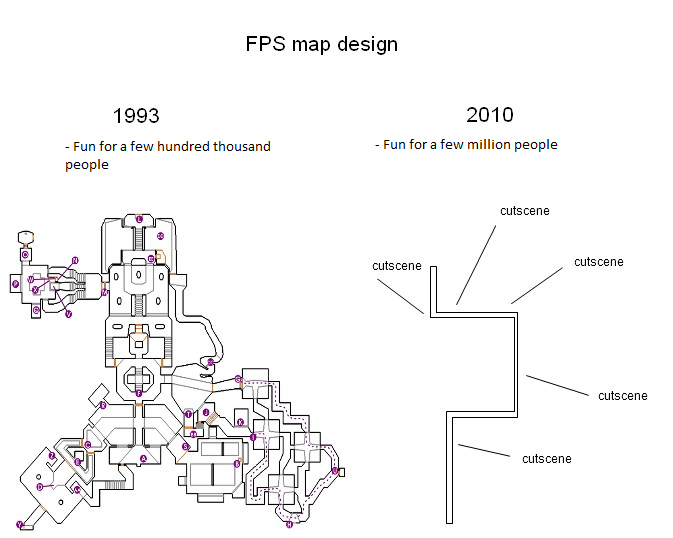
Doom also features level layouts that are, in my opinion, often vastly superior to the level design in many modern FPS games.  The image on the left (a meme floating around the net since 2010) is exaggerated for comic intent of course, your typical modern FPS isn't quite that simplistic in its maps, but it is true that compared to most modern FPS games, the maps in Doom are sprawling and complex.  It's easy to get lost, especially given how few textures they were able to cram in (again, hardware limits), but fortunately there's a built in map feature that helps you out.

Doom maps were also a first for FPS games because they were dynamic.  Platforms moved, doors opened and closed, pillars lowered to reveal prizes, and monsters burst from hidden doors to surprise you.

Doom both invited and rewarded exploration in a way that many modern games don't, and due to their mechanics often really can't; regenerating health and shields takes away the urgency of finding boosters in game.  Often Doom will give you a glimpse of a valuable prize, which can be seen easily but which can only be reached by hunting around for hidden doors or finding concealed elevators.  The player has to learn to look for out of place (or sometimes backwards) textures, and is rewarded for this by gaining access to better equipment.  Sometimes finding the secrets is the difference between life and death, no regenerating health means getting the healing packs is often absolutely essential.

The modern FPS could stand to take a lesson or two from Doom on level design, and how the level design lead the players to the secrets without the need for in game exposition or explanation.  Like the way first few seconds of Super Mario Bros is a perfectly designed tutorial on the basics of gameplay, the first few moments in Doom show you that there are areas in the game that require you to hunt for secret ways to access.  The very first thing you see as you begin play is a courtyard viable through a window, but not accessible through the window, with a giant glowing set of armor set on a pedestal surrounded by toxic waste.  The invitation to find a way to get to it couldn't be clearer.  When, at the end of a level, it shows you a percentage for secrets found, the urge to go back and play through the level again to bring it up to 100% is almost overwhelming for a certain type of gamer.

On the bad news side, it turned John Romero into a crazed ego monster who harmed the developer centered model of game design with the execrable Daikatana and the godawful hype built up around it that fed his ego.

But that to the side, Doom stands up well to the test of time.  It not only spawned a genre that continues to be massively popular, but at least in terms of level design it remains superior to many of its descendants, and remains playable and enjoyable to modern gamers, and a game that programmers have taken as a challenge to port to a truly ridiculous array of low powered devices.  That's an achievement not many 23 year old games can claim.

Tuesday, March 29, 2016

Sid Meier's Alpha Centauri, a review of a classic

Sid Meier's Alpha Centauri
Grade: A
Platform: Windows, Mac
Genre: 4X
GOG $5.99


Easily one of the best 4X games ever developed, available at GOG now for only six bucks, if you haven't played it yet just stop reading and go buy it and you'll easily spend a couple hundred hours playing before you realize it.

Or, if you insist there is more to say in review.

Positioned as a sort of thematic or conceptual sequel to the starship victory in the Civilization series, Alpha Centuri follows the colonists to their new home where they promptly split into ideology driven, as opposed to nationalist or ethnic, factions and start competing for dominance.

It plays largely like other games in the Civilization family tree, the most obvious mechanical difference being that unlike most other Civ games you can design individual units rather than just getting a default unit with certain tech advances.  But there is more to the difference than the obvious, some of the mechanics are significantly different from Civilization's model, and often better.  Alpha Centauri has a dynamic weather system and you can use terraforming to not only help your own society but to hurt your enemies.  Change rainfall patterns to make their crops wither, or even flood them via global warming.  The tech tree is improved as well and has an option for blind research that adds an interesting element to the game.

But what sets Alpha Centauri apart from the Civilization series is not just setting or tone, or even the mechanical differences, but the fact that Alpha Centauri has a story and characters.  The characters are developed mainly as you climb the tech tree or build wonders, each tech or wonder has a quote that is usually from one of the faction leaders and helps breathe life both into their faction and the leader themselves.  The story develops as you play, both in alterations to gameplay and in small text vignettes.

The planet, simply called Planet, is inhabited by life that's alien beyond even starfish aliens.  The dominant life form is a fungus, simply called xenofungus or "the fungus", and all the other life you encounter is deeply related to and basically part of the fungus.  The fungus is also telepathic and pre-sapient when you first encounter it, but grows into a person, a single mind, as it spreads over the planet.

At first the fungus is an obstruction, worthless in terms of resources, slowing down your units, and acting as a hiding place for mind worms which are exactly as awful as they sound; the discovery of fungicidal add ons for your terraformers seems like the best thing ever.  As you progress you can learn how to make the fungus the most valuable resource in the game, you'll be carpeting your territory with as much as you can manage and you'll curse your earlier efforts to get rid of it.

Alpha Centauri takes a decidedly transhumanist approach to things, allowing cybernetics, genetic engineering, brain mapping and upload, and more.  All of which fits the game perfectly and helps propel the story to its natural conclusion.

Each faction is clear, has advantages and disadvantages that fit its ideology, an agenda that makes sense given that ideology, and they will react to you based on your social decisions as well as your more overt diplomatic or warmaking decisions.  The AI isn't especially amazing, but it does a good enough job of providing a challenge.

In addition to the quality writing for the factions and the storyline in general, Alpha Centauri features well done voice acting for each faction leader that helps make them memorable.  The rich rolling voice of CEO Nwabudike Morgan helps establish him as the sort of person who despises most of humanity but makes a pretense of caring about the little people, while Sister Miriam Godwinson speaks with a subtle (and sometimes not so subtle), but threatening, air of conviction and righteousness.

If it weren't for the overarching story, the rich world building, the well developed factions, and the integration of transhumanist themes, Alpha Centauri would simply have been Civilization with different art assets (looking at you Civilization: Beyond Earth) and we'd have long forgotten it.  As it is, it stands out not merely as a well done member of the Civilization family, but also as one of the better 4X games yet developed.  This shows that it is possible to incorporate a story and characters into the 4X genre, and that if done well it can make the game vastly better.

It holds up very well, both in terms of graphics and gameplay.  Despite being 17 years old  the gameplay is still fresh (which says something not at all hopeful about the 4X genre, which seems to be stagnating) and the game entertaining and challenging.

The only expansion for the game, Alien Crossfire, is a mixed bag.  The alien factions are interesting enough, and obviously thought went into trying to make them alien, but the extra human factions mostly seemed cheap and lazy compared to the original factions, a couple stood out as worthwhile but mostly they were bleh. Mostly it is worthwhile for the gameplay improvements, the addition of fungal towers we very good, and some of the added tech improves the game greatly. Fortunately it is possible to use the improvements of the add on without bothering with the somewhat inferior factions it included.

The combination of a fresh take on the 4X genre, the well executed world building, the addition of personalities, characters, and story to the 4X genre, all combine to make Alpha Centauri a game truly worthy of an A.

Tuesday, March 22, 2016

Dishonored, a look back before the sequel

Dishonored
Grade: B
Platform: PC, 360, PS3
Genre: Stealth FPS RPG
Price: $29.99 GOTY

Dishonored is an example of how well executed world building can team up with solid gameplay and make a game memorable despite a paper thin story and cardboard characters.  It's also an excellent example of how limitations can spur creativity. 


The limitation in question is the fact that Dishonored was one of the last games to be designed for the Xbox360 and the PS3.  Despite being released in 2012, a time when most gaming PC's were equipped with at least 8 gig of RAM, it had to run on creekingly antique hardware that had, in the PS3's case, a mere 256 megabytes of RAM (that's about 62 times less RAM than a gaming PC of the day).  The CPU and GPU of the Xbox360 and PS3 were similarly underpowered, being around 16 times less powerful than 2012's processors.

All of which meant that Dishonored should have looked awful by modern standards, built on obviously low poly models and with textures that made everything look either cartoonish or muddy.

In reality, Dishonored was strikingly beautiful and still stands out as one of the better looking recent games.  How?

By taking the limits of the systems to heart and building a visual look that would work well inside those limits and fit the world as presented.  Dishonored abandoned any attempt for photorealism and embraced a style that made it look as if the player had stepped into an old oil painting.  It meshed perfectly with the world they were presenting, and the tone of the story.  Rather than being muddy, Dishonored is muted, rather than being blocky it is simple.  All of which helps to convey the mood of the world, and helps mask the gaping void where an entertaining and well plotted story should have been.

The single best thing about Dishonored is the world building, the setting is lovingly crafted, you get the impression of a world that goes well beyond the borders of the game. Even, or perhaps especially, the minor characters seem to fit and have a story and life larger than their role in the game.  This is helped by mostly above average (and occasionally excellent) voice acting and music.  

The gentle Cthulhuoid monstrosities so casually referred to as "whales", the religion that has been based almost entirely around opposition to what is apparently the only source of genuine magic in the world, the dying city, and the technology which is wholly based on "whale" oil (to say nothing of the torture involved in extracting it), all fit together beautifully and mesh with the hints of the larger world beyond Dunwall with each element reinforcing the mood of the setting and story.  Even the costumes, in so many games largely ignored leaving characters dumped into costumes that either don't fit the setting or are taken straight from history and break immersion, reflect a thoughtful design influenced by, but not bound by, actual historic costumes.

Even better, for the most part the game gets out of your way and allows you to enjoy the world by having a well done interface.  I can't speak for how it played on a console, but on the PC the controls were smooth and didn't intrude into the game beyond the absolute minimum. 

All of which is good, because without such a well developed world,  mood, and interface, the game would have had to rely on the characters and story, and it would have been largely forgotten if it had.

Apparently having expended all of their creative energies on the world, the developers at Arkane seemed to have little left for the main characters and the plot.  The plot is a bog standard revenge tale motivated by the worn out and tired trope of the dead love interest and/or kidnapped love interest.  Arkane decided to go with both: a dead lover and a kidnapped daughter.

Corvo is, say it with me everyone, a grizzled male silent protagonist.  Someone must have spent a full minute or two thinking that one up.  Like all grizzled male silent protagonists, he needs a shave, has a scar or two, and is ruggedly handsome in a brooding sort of way.  Yeah, just like the dozens, if not hundreds, of other grizzled male silent protagonists you've played.  They broke the mold a bit, rather than a buzz or shaved head, he's got tousled dark hair, but eh.

Most of the other major characters slot neatly into well worn tropes.  There's the socially awkward genius engineer, here's the politically ambitious general, and look over there is the corrupt aristocrat complete with the loyal servant.  The open villains are similarly shopworn, and when the inevitable betrayal plot element comes up it is with a long expected inevitability that couldn't have been more blatantly telegraphed if they'd actually telegraphed it.  You have to wonder if perhaps Corvo just isn't all that bright since he apparently didn't see it coming.

For the most part, the beautifully realized and executed world, the tight gameplay, and the pacing of the game help to keep you sufficiently distracted that you don't (much) notice how the plot is so well worn that you knew it by heart from the first scene, or that the characters are all made of cardboard.

There are a few exceptions, Emily doesn't fit easily into any established princess trope, for example.  And despite being a bit unoriginal, the Outsider is just too awesome not to love.

If the plot and characters had been given even a tenth of the attention that was given to the setting, the game as a whole could have been so much better.  

There's a degree of improvement in the DLC.  Daud gets a bit more fleshed out, though he's still rather shallow, but Billie Lurk is actually a good character, and while Delilah Copperspoon isn't all that original, nor is her plot, she's got a bit of zip and manages to avoid the worst of the femme fatale tropes that could have caged her in and made her more boring.

So here's to hoping that in Dishonored 2 they spend a bit more time on plot and character, and have the same attention to detail and world building that went into the first. If Dishonored 2 manages to keep the good stuff from Dishonored and include better characters and plot, it'd be worth an A.

Friday, March 18, 2016

Team Fortress 2

Team Fortress 2, the only game you really need, and the world's best hat simulator

Grade: B
Platform: PC, GNU/Linux, Mac
Genre: Team FPS
Price: FREE!

Released in October of 2007, TF2 is not the oldest game I play and advocate for, but its definitely on the older side of things.  It is, however, still one of the better games that exists and one that a lot of people turn to when they can't decide what to play. It has hats, and fun filled promotional videos. What more could you ask for?

Unlike most competitive games, TF2 has a community that is generally friendly and not made of the sort of tantrum throwing types that make most MOBAs a nightmare to play. Whether this is due to the quick nature of the games, the way the teams are autoscrambled when one side wins too much, or just the age of the game, I'll leave to social scientists to sort out.  Bu the result is a community that typically ranges from pleasant to meh, I honestly can't recall any time on public servers that I encountered someone throwing a tantrum, or even really being much of a jerk beyond the very passive aggressive jerkdom of being AFK during a fight.

TF2 is a game that is balanced by being unbalanced.  There are nine classes, and each has a blend of strengths and weaknesses that keeps any from being OP.  A team needs at least one of each class just to make up for the deficiencies each class has, and there's ways for even less skilled players to contribute.  There's always a shortage of medics, its a fairly easy class to play (though you will die often, because medics are always a top target), and while following around a Heavy or Pyro you can learn the map.  

I would recommend looking at the wiki for at least an overview of a how a class works and what the expectations are for that class, that way when you're playing Pyro you'll know that you need to spy check.

There are a variety of game modes, the classic King of the Hill and Capture the Flag (ahem, sorry, "intelligence") are there, but the busy people at Valve have been steadily adding content, the most recent released only a couple of weeks ago, including new play modes which keep things fresh, though for my money the Payload game is still the most fun.  Though there is something to be said for loading beer into an alien UFO to make it crash before the enemy team can do the same.

The only downside to TF2 is that all nine classes are men, and other than the announcer women basically don't exist except as the pinup girls in the locker rooms.  But the erasure of women is, regrettably, not something that really makes TF2 stand out, so I'm willing to count it as a good game despite that.

Since TF2 is an older game, it can run on older or less expensive hardware with a nice silky smooth framerate. And, despite being older, it doesn't show its age much, I'd say in large part due to the cartoonish graphics that don't try for photorealism.

More to the point, TF2 is simply fun.  It isn't grimdark, it isn't hyper competitive, its just a good time, and one that doesn't take a huge time commitment.  But despite a shallow learning curve, there is a fair amount of complexity to the game, but you don't actually have to know the details of when and why you might want to use the Axtinguisher instead of the Frying Pan.  

You can load up TF2, hop into a game, and play for several hours, or just a few minutes, and it'll be fun either way, and it is that casual aspect that keeps players coming back when they look at their giant library in Steam and can't decide what to play.  For that reason alone, "screw it, I'll play some Team Fortress" may as well be the unofficial motto of PC gamers everywhere.

There are also hats.

Thursday, March 17, 2016

Stardew Valley, the only RPG/dating sim/farming game you'll ever need

Stardew Valley

Grade: C
Platform: PC
Genre: Farming, dating sim, rpg
Price: $14.99

A rarity even in indy games, Stardew Valley is wholly the creation of a single person.  Eric Barone did the coding, the writing, the art, the music, everything.

The result looks like it'd be at home on a Super Nintendo, and that's a good thing.  The 16 bit style graphics add a needed note of whimsy and unreality to the game, reminding you that it isn't really a farming simulator but a game that uses "farming" as a mechanic.

Despite being billed as a farming game, a good portion of the game is a dungeon crawl with an RPGish feel, coupled with a ruthless bit of resource management, with that last being essential to gameplay and much of the challenge.

Your character has a limited endurance, and that pool is consumed when you do much of anything.  Fishing, farming, harvesting crops, fighting monsters, mining for ore, chopping down trees, all consume your energy forcing you to carefully consider what you'd like to do in any given day.  Adding to the problem is that you can't work too late into the day or your character will pass out and you'll be penalized with even lower energy the next day.  And that some things can only be accomplished at certain times of day, or certain weather conditions, or seasons, or days, etc.

Managing your character helps keep the farming from getting boring, as does the variety of available tasks.  If you're bored with farming you can go fishing, or chop wood, or go exploring the caves, or go try to woo a romantic partner.

Because yes, Stardew Valley is also a dating sim.  With all the often squicky problems that dating sims come bundled with.  

Gamifying human relationships is always a fraught exercise.  But in a way Stardew Valley navigates the problem with minimal difficulties.  In part, I think, due to the simple graphics and gameplay that harken back to the older systems it feels less wrong to render human relationships almost entirely as buying someone's love with money.

Because that's how Stardew Valley mostly handles relationships.  Want to date someone?  Give them presents and they'll eventually be your date and marry you.  There's a few added elements, some conversational options similar to the stuff you'd see in a Japanese dating sim, but mostly if you want to pursue a relationship with any of the single people in Stardew Valley you simply find out their favorite product and give it to them repeatedly until they agree to marry you.

Since the rest of the game has a simplified feeling, the purchasing of affection through presents doesn't come across as badly as it sounds at first.

Still, it'd be interesting to see a game where romance options involve some randomness, where every time the game starts some randomly determined characters just aren't that into you and you've got to find that out the hard way.  At least it'd be different.

I will say that Stardew  Valley at least takes a refreshing approach to LGBT issues that fits with the rest of the highly simplified tone of the game.  There are ten single characters you can try to date, five men, five women, and you can pursue any of them regardless of the sex of your character.  Getting a date with a guy, as a guy, plays out exactly the same as getting a date with a girl as a guy.  Bring your intended lots of presents and you'll score.

Even with my reservations about the dating aspect, the game is entertaining and well worth the purchase price.  A solid, averagely fun and enjoyable game.

Monday, February 29, 2016

Factorio, or why I may never see my family again

Factorio
Grade: B
Platform: PC, Mac, GNU/Linux
Genre: Building, supply chain management, resource management, sim
Price: 20€
Site
Steam

Odds are good that when you saw the genre entry for this review, you had one of two reactions: puzzlement, or joy.  For the puzzled among you while its true that many (if not all) games have an aspect of resource management some games are more focused on that part of the game than others.  Factorio is really nothing but resource management.

You have to mine iron to make iron plates.  But you have to mine coal to fuel your smelters which turn raw iron ore into iron plates.  You have to use factories to turn iron plates into iron gearwheels.  You have to use iron gearwheels and iron plates to make conveyor belt segments.  You have to use conveyor belt segments to......

If your eyes glazed over there, then Factorio is probably not for you.  Try the demo anyway, its free and you might find you harbor a previously unknown love of supply chain management.  If, on the other hand, you're the kind of person who really started loving Dwarf Fortress when you discovered how detailed the game was when it came to making goods, then Factorio is right up your street.

Factorio is about building a factory complex, shuffling the raw materials around to make finished goods, and shuffling the finished goods around to make even more complex finished goods.  For a game of this sort it has a startlingly small number of resources: copper ore, iron ore, wood, water, coal, and oil.  That's it.  But they're combined, refined, reprocessed, and produce a plethora of goods and intermediate products, and every single thing needs to be moved from where it was produced to where it is needed.

You'll discover that to avoid making a factory as tangled as a plate of spaghetti, and one that's nearly impossible to expand, you'll have to make your factory sprawl.

There's alien bugs who hate pollution and will attack, but they're mostly included just to add more challenge and to force you to expend resources defending your factory.  Combat is meh at best, in the traditional sense, but it fits the theme rather well since the whole point of the game is automation so it makes sense that the focus of combat is on automatic turrets (so far I've found the easiest way to beat the bugs is to "walk" turrets to their hive).

The problem with games of this nature is that their appeal largely rests in the learning curve.  Figuring out how to make a factory work is the challenge and once you have it cracked you either go completely obsessive and refine everything to the utmost, start trying to see if you can build a Turing Machine in game (you can), and otherwise really get into it, or you lose interest and wait until the next game comes along and can consume you until you've learned all its secrets as well.

Factorio hopes to avoid that by encouraging a vibrant modding community, as a result the game is very mod friendly and has a nice interface and lots of modding support.  So far the mods are looking good.

All of which is doubly amazing since technically Factorio is still in pre-release and the developers don't think its anywhere near finished.  Despite having been available through factorio.com for quite a while, it is only very recently available on Steam and that only through the early access program there.

However, unlike most early access games, which often seem like varying degrees of scam, Factorio is polished enough it could be called a finished product right this second.  There's lots more the developers intend to add, but if they were all hit by the hypothetical bus tomorrow Factorio would still be well worth the price.

Tuesday, February 16, 2016

War For the Overworld


War for the Overworld
Grade: C-
Platform: PC, Mac, GNU/Linux
Genre: 4X
Site
Steam


War for the Overworld is really Dungeon Keeper 3, it can't be called that for copyright and trademark reasons, but it's DK3.

And that's both good and bad.  Hardcore DK fans like me have been clammoring for DK3 ever since DK2 was released, so it seems a bit churlish to give it a less than stellar rating when it finally does get released.  But I've got my reasons.

WftO has a lot going for it, to begin with they got Richard Ridings the original voice actor for the mentor from DK1 and DK2 to voice this game as well, and his silky yet sinister tone was always one of the little joys of playing Dungeon Keeper.  The WftO designers also must have been working hand in glove with the legal team to skirt as closely as possible to violating the trademarks and copyrights on Dungeon Keeper without actually stepping over the line. It looks like Dungeon Keeper, it feels like Dungeon Keeper, it sounds like Dungeon Keeper. 

So why a C- instead of a C or a C+?

A variety of reasons, beginning with poor support for post-campaign play.  There is a not very well designed sandbox mode, the inevitable PvP mode, and the promise, or perhaps threat, of DLC in the future.  Compare to DK2's rich post-campaign play and it doesn't hold up.

There's also the problem that while they did innovate a bit, much of what they came up with was mediocre at best.  I did like some changes.  The mana pool is better managed than it was in DK2, they made mana regenerate at a flat rate and took out the abuse inviting mechanic of allowing prayers in the temple to generate mana.  I honestly think DK was better without mana, the DK1 mechanic of paying for spells with gold seemed like a better option, but if we must have mana there is no doubt that WftO handles it better than DK2 did.

Unfortunately that's the only new thing in WftO that was a real improvement.  I like the idea of the alchemy lab, but found the implementation and the range of potions wanting.  I liked the idea of rituals from the dark temple, but like the alchemy lab I found the implementation wanting (how did sacrifices work exactly, it was never really easy to tell) and the rituals themselves a bit bland.
Then there were the unnecessary add ons, the tech tree was kind of pointless really.

Where the game really suffered was in a failure to take risks.  It isn't so much DK3 as it is a loving recreation of DK2 with a few pointless add ons, and a short campaign.  Worse, they kept the parts of DK2 that weren't all that great, and the parts of DK2 where it became less innovative than DK1.

The best part about DK1 was the inversion of aggression.  In most games the player is the aggressor, the one who dictates the tempo of the game, the one invading the enemy and crushing them.  But in DK1 all that was reversed.  The player was a passive defender, the game dictated its own tempo for the most part, and with a tiny few exceptions the player was the one being invaded (though if they planned well of course they were party doing the crushing).  DK2 and WftO changed that, it is always the player doing the invading and taking the active role.  The joy of building a dungeon filled with traps and lurking monsters waiting to destroy would be heroes who would dare try to steal your gold is not a part of DK2 or WftO and I miss that and I miss the bold innovation and role reversal it entailed.

They also kept the Dungeon Keeper combat system, which is both understandable (imagine the wailing if they changed it and it wasn't very fun) but also disappointing.  Combat is easily the worst part of the entire series, it was never anything more than grabbing your monsters and dropping them into battle then hoping you outnumbered the enemy (or in DK2 hoping you'd managed to get all the Dark Knights while leaving your opponent stuck with the goblins).  Combat in WftO is exactly the same, and that's a point really driven home in the level where you have to fight off several other Keepers (ahem, sorry, "Underlords") and the whole thing is basically a bunch of dropping and occasional smiting of enemies with lightning.  Of all that parts of DK that cried out for change and innovation it was combat that called the loudest, and those calls were ignored.

WftO does away with the DK2 mechanic of a shared pool of potential recruits that all Keepers must compete in, but it makes getting hordes of monsters somewhat difficult. Each building will only summon a tiny number of minions, and buildings cost gold and land.  In a way this is good because it can force you to throw minions into combat you otherwise wouldn't, but its also bad because it makes expansion more a matter of deciding which minions you need the most and building more of their rooms than any other consideration.

I'm iffy about the plot of WftO as well. It was short, had an abrupt end with no real demounement (not something I object to, but something of a risk and apparently one that many other players did object to), and while neither DK1 or DK2 had much in the way of player choice in the plot, the way it was presented felt more natural and less forced than it does in WftO.  You had a home realm that seemed like it'd be fun to decorate and fix up with your newly acquired rooms, but trying to do so resulted in the dark god harassing you every few minutes to get back and finish the campaign which kind of detracted from the potential fun there.  Through the entire game you're the pawn of the dark god, and not an unwitting pawn but rather a pawn who is constantly told that they are a pawn, which got old after a while.

What's worse, the plot sometimes had you do something it claimed was important (beating up the other Underlords to make them serve you) but then apparently forgot about that and their servitude was never mentioned again, you never used them for any purpose, it was just sort of left hanging.
Overall, if you want to relive DK2 with better graphics I'd say WftO is a good buy. It's also pretty fun on its own merits, if nothing spectacular.  Personally, I'm loading up DK1 and DK2 from GOG and playing them again.

Friday, September 4, 2015

Civilization: Beyond Earth, or Alpha Centauri II (sort of)

Civilization: Beyond Earth
Grade: C-
Platform: PC, Mac, GNU/Linux
Genre: 4X
Site
Steam


The good news is, Beyond Earth is basically Sid Meier's Alpha Centauri 2.  The bad news is, Beyond Earth is basically Sid Meier's Alpha Centauri 2.

Like a great many sequels, this one definitely lacks something.  And what it lacks isn't a vague je ne sais quoi, but pretty clearly and easily explained.  But first, let's examine the good, and there is a surprising amount of good considering the low grade I've given the game as a whole.

I get the impression that in a lot of ways we're looking at many of the innovations the Civilization V designers wanted to include in Civ V, but weren't allowed to for fear it'd be too radical a departure from the standard Civilization experience.

Sometimes this is a very nifty approach that I'm sorry that Civ V was too stogy to use.  For example, when you build the first of most newly researched buildings, you're presented with a choice of (usually) two ways you can customize it. I might chose to save energy by having my relics maintenance free, you may chose to pay maintenance on relics but get extra culture from them. It allows for the player to minmax a bit based on their play style.

Likewise, rather than simply replacing old units you get choices in how they can be upgraded.  I don't approve of this as much as I do the building customization because rather than having the freeform units of Alpha Centauri you are given a much more limited set of options based on your ideological choices.  But at least there's some player choice involved, and that's never a bad thing even though it could easily be better.

Unfortunately, some of the new ideas just don't work, I don't know if the devs just didn't want to risk making things too different, or if there was executive meddling, but some changes simply feel timid.

The tech web is a perfect example of this.  Rather than a simple tech tree that everyone climbs and by endgame you either have all the technologies listed or you're just playing badly, Beyond Earth has a genuine tech web.  I suppose it might be possible to get all the techs in a single game, but I haven't yet.  In theory, that would allow for diverse and varied gameplay as you use different parts of the web from your opponents, or change your game style by exploring different techs.

Unfortunately, in practice, the tech web is kind of bleh and really your choices there don't make as much difference in gameplay as you'd hope.  Nor, really, do the choices between the three ideological options of purity, supremacy, and harmony.

So rather than having to make truly hard, game changing, decisions based on the tech you choose to research, the only real factor in your decision is simply what victory condition you want to chase.  A player who has chosen a supremacy ideology and the emancipation victory won't have a game significantly different from a player who chose a harmony ideology and the transcendence victory. And that's a major disappointment because the game has so much potential.  The ideologies are intriguing, and if they and the tech had been more significant and produced different interactions with the game based on those choices it would have been truly wonderful.

We also have the problem of the publisher stripping out big chunks of the game to sell as DLC. The first is already available and allows ocean buildings and more oceanic options as well as adding more factions, improving diplomacy, and so on.  I expect we'll see another coming soon to expand on the anemic orbital game.

What disappoints the most is that Beyond Earth is, kind of, sort of, a sequel to Alpha Centauri.  And that's a problem, because they couldn't use Alpha Centauri intellectual property, that belongs to EA not Fireaxis.  This means that often they tried to duplicate Alpha Centauri ideas, but without referencing the forbidden IP.  Sometimes, some games, some publishers, this can work.  It didn't work for Beyond Earth.

The transcendence victory is clearly a call back to Alpha Centauri.  The problem is that in Alpha Centauri there was an overarching plot involving the planet's fungus being sapient effectively making the whole planet a single mind, so in Alpha Centauri the transcendence victory flowed naturally from the game as a whole.

But in Beyond Earth it just doesn't make sense.  There is no overarching plot of any sort, the aliens are just kind of buglike and it is never indicated that they are intelligent even individually much less collectively, so the idea of joining a planet mind in a telepathic rapport just doesn't fit the game.  But the option is there, because Alpha Centauri did it.

Worse, they didn't try for anything interesting or new in what little plot the game has.  Alpha Centauri had a story, an intreguing story that the player discovered through the tech quotes, through gameplay, through bits of short fiction that popped up at significant events.  It had factions that were believable and interesting and lead by characters who exemplified a single trait but had personality beyond that one trait.  Miriam Godwinson was a religious fanatic to be sure, but there was more to her than just that.

There is no real story in Beyond Earth, the factions are bland and mostly indistinguishable, the faction leaders are mere faces and names.

There are three voice actors, total.  All the tech quotes are done by one actor, and she's fine and does a good job, but it seems kind of limited when compared to the quotes from Alpha Centauri.  Worse, since there isn't an overarching plot, and all the factions are kind of blandly similar, the tech quotes don't - can't -  reveal anything about the factions and their leaders.  When compared to Alpha Centauri in this aspect it falls horribly short.  And frankly, it doesn't do all that well in comparison to the blander Civ tech quotes either. While in Civ the quotes are often meaningful historic quotes, all the Beyond Earth quotes are made up which which would be OK if they told us more about the game setting, but they don't.
I really want to give Beyond Earth a better grade, I loved Alpha Centauri, I applaud efforts to make a sequel, I love that they made it available for GNU/Linux, and I am delighted with the effort to go beyond the Civ restrictions and do newish things with the series.

But, at the end of the day, it just falls flat.  I still play Alpha Centauri, but after finishing three games of Beyond Earth I doubt I'll play much more.  As DLC for Civilization V it'd be fantastic and I'd probably have given it a higher grade.  But as a stand alone game there just isn't enough content to justify the price.

Wednesday, September 2, 2015

Master of Magic - A retrospective review

Master of Magic
Grade: A-
Platform: Anything that supports DOSBox, originally PC
Genre: 4X before it was called 4X
Site
Game Wiki

Released in 1994, Master of Magic is now old enough to drink.  And despite being a game well worth playing, it shows its age.  People who weren't fans back in the day may not be able to get past the antique graphics or the clunky UI, but if you can the game beneath is something amazingly good that still hasn't been really successfully duplicated.  If you like 4X games you owe it to yourself to try Master of Magic, it's cheap through GOG. There is also a Master of Magic remake, of course, and I'll be reviewing it later, but I recommend the original for the 4X fan who hasn't tried it yet.

Master of Magic was released shortly after Master of Orion, [1] and was intended as a sort of companion or counterpoint to Master of Orion.  Like Master of Orion, Master of Magic features a blend of strategy and tactics, the main action takes place on the world map but when combat begins the player is given a tactical map and interface to direct individual units.

It wasn't originally well received, it was buggy and the AI was broken on release, but that was patched and the game became enshrined in the hearts of 4X fans.  So don't let anyone tell you that releasing a broken game and then patching it post release is all that new, they were doing it back in 1994 too.

Master of Magic is a somewhat odd beast, and my grade of A- may well be tainted by nostalgia but I don't think so, it really is an amazing game.  An amazing game that had many problems baked right into the core mechanics, things that were lamented at release, but in retrospect turn out to be why, 21 years after release, people like me are still playing it from time to time.

To classify the problematic, yet in a weird way good, aspects of Master of Magic I'd say that they make a sort of accidental form of asymmetric game play.  The simple fact is that Master of Magic is not balanced.  At all.  If you start as a human you get access to the full tech tree and the paladin special unit which is immune to magic and can curbstomp pretty much any other unit in the game.  If you start as a lizardman you get a tech tree that's more of a tech shrub and your units can swim.

Yet, despite that, you can win playing nothing but lizardmen.  It requires a completely different play style than winning playing with humans, or high elves, or orcs, or any of the other "better" races, but it is possible.

Magic is similarly unbalanced.  Magic is broken into color based schools, green for life, white for healing, red for destruction, black for evil, blue for air and metamagic, and some are simply better than the others.  It is undeniable that the magic in Master of Magic is as unbalanced as the races.  Start with blue magic and you can summon Phantom Warriors, who mow through most early game units easily, and by late game summon Sky Drakes and throw lightning bolts with enough power to one shot just about any unit.  Start with white magic and you might as well not bother casting spells until mid to late game, and even then your spells will suck compared to blue or red, or even black or green, spells.

And yet...

And yet that very lack of balance is why I keep playing.  Never mind that Master of Magic helped define the 4X game, never mind that it was a truly innovative break from Civilization and Master of Orion.  The fact is that the lack of balance made the game fun and challenging in a way that even modern AI (which often isn't really that much better than antique game AI) or multiplayer often lacks.

Because you CAN win playing a wizard with all white magic and nothing but lizardmen.  You've got to take a human wave approach to combat and expansion, you've got to use your magic to maximize population and healing, you have to hit your enemies fast and hard before they can start pumping out units that will smash your armies solo, it's risky and you may lose horribly, but it can be done.  And succeeding with all the odds against you feels damn good.

There are a handful of deliberately asymmetric games out there, AI War is the canonical example but Sorcerer King represents an attempt to intentionally achieve what Master of Magic did (I think) purely accidentally.  Asymmetric games are hard to design because the whole point of them is that they're unfair, and making something unfair fun, winnable, and challenging is difficult to say the least.  That Master of Magic succeeded in doing it basically by accident is amazing.

One of the ways Master of Magic succeeds is with a game that had a sandbox feel before the term sandbox had been invented.  They developed a game with a greater variety of units, a huge number of spells and magic effects, and allowed the players to mix and match as they chose.  The ability to customize your wizard allows you to minmax traits and spellbooks to create an unstoppable force of nature who can stomp through the game even on impossible difficulty with no real trouble.  Or you can go the opposite route and make a wizard who has a mix of traits and spells you think simply can't win, and then win anyway.

And, unlike in some games featuring magic, the magic in Master of Magic can truly shake the world.  At high levels you can not merely rise individual volcanoes, you can cast a spell that will automatically rise several volcanoes every turn (except in your cities of course) and eventually reshape the whole world into a hellscape of lava flows.  You can cast spells that plunge the world into eternal night, or slowly corrupt every bit of terrain making it unlivable.  You can cast spells to raise every fallen soldier as a zombie in your rotting undead army, or stop time for everyone but you so you can smash them piecemeal and steal their resources in the blink of an eye. Every one of those spells is horribly unbalanced, and fun in a way that the carefully balanced play of most games simply can't match.

Master of Magic is a game that no major studio would dare release today.  But it's good, and you should try it.

[1] Nostalgia is always profitable so naturally Master of Orion is being rebooted.  Here's the Steam page.

Tuesday, September 1, 2015

Fallout Shelter, a free to play done right

Fallout Shelter
Grade: C
Platforms: iOS, Android
Genre: Resource management

Site: http://www.falloutshelter.com/

Fallout Shelter is an excellent example of the often rightly hated free to play model done right.  It's also a fun enough little resource management game.

Made to help generate hype for the upcoming release of Fallout 4, Fallout Shelter is enjoyable on its own even for people who have never played a Fallout game, though presumably most people who download it are Fallout fans.  There's not much to the game, no real objectives beyond collecting all the costumes, weapons, and special characters.  Like many mobile games it is intended to be played in brief bursts, not over long period.  There isn't much difficulty.

The graphics are based off the classic Vault Boy design and have a nice cartoonish look that clashes pleasantly with the gruesome violence of the universe, just as the original Vault Boy design was intended to.

Gameplay consists of assigning the characters with the right attribute to the various jobs, balancing training attributes vs. producing resources, fighting off the occasional raider or deathclaw invasion, and dealing with random infestations of radroaches, molerats, or a fire breaking out, and sending properly equipped characters out to scour the wasteland for guns, costumes, and occasionally special characters.

Like many burst play style mobile games, Fallout Shelter has a timer attached to most events. To have even a roughly 1 in 10 chance at getting the extra special goodies from the national guard depot you must have a character exploring the wasteland for 60 real life hours, and then have them spend 30 real life hours trudging back to the vault.  Rooms produce resources at a rate that varies depending on the stats of the Dweller assigned to that room, but it ranges between slightly less than a minute and fifteen minutes.

Unlike most free to play mobile games, there is no way to exchange real world currency to sidestep those timers.

In fact, you can buy exactly two things with real life money.  The first is Mr. Handy, everyone's favorite hovering betentacled flamethrower armed robot, who will wander the floor where you place him collecting resources so you don't have to.

The other thing you can spend real money on is extra lunch boxes.  You can get lunch boxes through normal game play by completing randomly generated assignments.  The lunch boxes contain a tiny assortment of resources, and a rare or semi-rare character or item.  It's those last you really care about of course.  The lunch boxes you buy are superior to the ones you get through playing, purchased lunch boxes are guaranteed a rare character or item, while the ones you get through playing occasionally only have normal things.

The only major objection I have is that on the Android there is no pause function other than quitting.  When you switch away from the game it continues to run in the background, your vault dwellers continue to consume resources, but since getting resources requires you to tap the room where they are generated they quickly run out and starve if you forget to quit instead of just hitting the home button.  If you have a Mr. Handy on all the resource producing floors that's actually a kind of good thing, as you can let the game run in the background and stock up on things without having to bother with the tapping.  If you don't have a Mr. Handy then it results in unhappy vault dwellers, and possibly a deathclaw attack ripping through your vault and killing everyone.

Since it can take upwards of thirty seconds to a minute to load once you've quit, frequently quitting is annoying.

My biggest minor objection is that using stimpacks on your dwellers before they die during attacks is sometimes frustrating because they clump together making it hard to tap the right dweller. I suppose you could argue that's an intentional design choice to increase difficulty, I suspect it's just a mistake on the developer's part

Overall, it's a perfectly enjoyable way to kill a few minutes while you wait for the bus and I have no doubt that other fans of the Fallout series will enjoy the in jokes.  If you're like me, you'll become obsessed with collecting all the canonical characters available (so far all from Fallout 3 except for a couple of Fallout 4 preview characters, but doubtless New Vegas and 1 & 2 characters are on their way).