 Doom
DoomGrade: B+
Platform: These days literally everything including toasters, originally PC
Genre: FPS before there was FPS
GOG $5.99
Released: 1993
Doom was far from the first FPS game (there were FPS games going as far back as 1974 even though the acronym hadn't been invented yet), but in a lot of ways it is the origin of the modern FPS game. And yet it differs in a great many critical aspects from virtually all modern FPS games, some good, some bad, and some just different.
Of course, Wolfenstein 3D came before Doom, but it was Doom, not Wolfenstein, that took the title of granddaddy of FPS games, and until the term FPS was invented people described FPS games as "Doomlikes" or "Doom clones".
A good place to start with Doom is what it doesn't have, or didn't require.
Doom is not, actually, 3D. It pretends to be, but it isn't. You aim only horizontally and there is no vertical control at all. This is sometimes a bit jarring, such as when you meet the first imp and it is standing on a raised platform, but you can shoot it despite your gun clearly being aimed at the platform, not the imp.
Doom does not require a mouse (though it can use one and only the most masochistic modern gamer will try it without a mouse). In the dark days of 1993 mice were still far from standard peripherals and a great many people, even gamers, didn't have them. I didn't when I first got Doom, in fact playing it through again for this review is the first time I've ever played Doom with a mouse.
Doom has no shields.
Doom has no regenerating health.
Doom has no regenerating anything.
Doom, compared to modern FPS games, has a shockingly low rate of fire for most weapons.
Games evolve, and Doom is ancestral to the modern FPS, but still clearly shows its descent from other games and gaming styles. Clearly one of the parents of Doom was the shooter game, a genre mostly extinct but with a closely related descendant genre in the bullet hell style of game. In shooter games, the player moves quickly, usually much more quickly than the enemy bullets, and gameplay involves dodging enemy shots. Doom is like that, with the player zipping across the battlefield at high speed and dodging enemy bullets as he goes.
In the modern FPS the idea of dodging most enemy attacks is simply absurd, but it is a critical component of Doom. Enemies fire attacks that crawl towards the player not merely allowing, but demanding, that the player dodge them.
Because, as noted above, nothing in Doom regenerates. There are no shields, and your health is limited, and enemy attacks take off a lot of that limited health pool if they hit.
The modern FPS turns the player into a meat shield, while seeking cover is both good and necessary, it is understood that the player will be shot, several times, during any encounter, and that in between encounters the player's health and shields will fill back up, or that the player will even hide behind cover at least long enough for their shields to recharge.
In Doom you dodge or you die, and a skilled player can dodge virtually every attack directed at them. This clearly shows a common ancestry with games like Galaga and Vanguard.
Also unlike your average modern FPS, Doom isn't much on story. Sure, there's an instruction manual that talks about Mars and demons and so on, but the story isn't in the game. You shoot demons, find keys, and shoot more demons until you can get the BFG and kill the big boss demons. There's your story chum.
Doom came from an era when games were, mostly due to hardware limits, fairly sharply divided into story intense but graphically limited and mechanically limited games, and games with little story but detailed and snappy game mechanics. Doom fits unapologetically into the second category. It is a game, first and foremost, about playing the game. Story is crammed in as a far distant second priority, and the game doesn't really suffer for that.
Where Doom shines is in gameplay and level design.
Once you remap the controls (using a separate utility, no in game keymapping supported) to use WSAD, with A & D being strafing rather than turning, Doom is a game with tight controls, allowing you to dodge enemy attacks with ease, while positioning yourself to take down the enemies with a few well placed shots. I have absolutely no idea how I managed to win the first time I played Doom with the default keybinds (and no mouse) way back in the day, but I managed it somehow.
As mentioned earlier, Doom has remarkably slow animations and firing on the first two weapons. Your pistol fires only once every half second or so, and the shotgun takes at least a full second to ready before it can be fired again. This requires you to play defensively, dodging around while you arrange matters so your slow firing weapons can take out enemies. Later weapons sometimes have faster firing (the chaingun wouldn't be a chaingun without a high cyclic) but many still retain a much slower rate of fire than many modern gamers expect. You mostly can't just spray and pray, you must aim, and that's a bit tricky sometimes due to the lack of a targeting reticle.
Doom is hard, and that's part of the point and joy of playing. Back in the old days games tended to be harder than modern games, and Doom is no exception. I can understand why game difficulty was decreased, but I often wish games had at least an option for greater difficulty (even BioShock Infinite's 1999 mode wasn't really that hard)
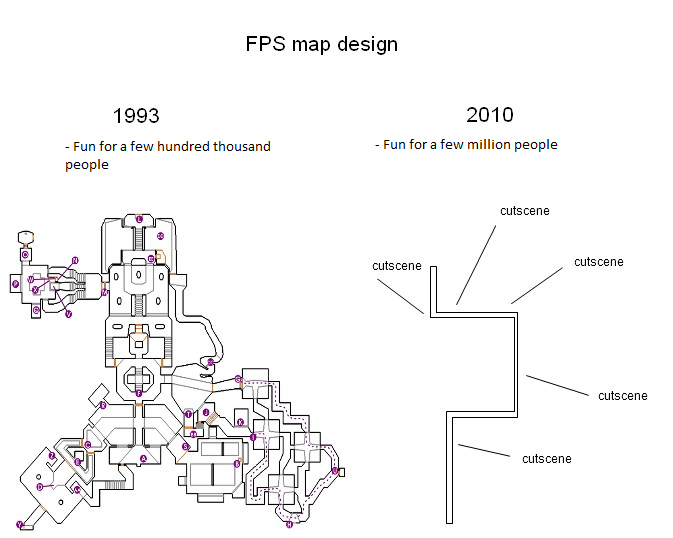 Doom also features level layouts that are, in my opinion, often vastly superior to the level design in many modern FPS games. The image on the left (a meme floating around the net since 2010) is exaggerated for comic intent of course, your typical modern FPS isn't quite that simplistic in its maps, but it is true that compared to most modern FPS games, the maps in Doom are sprawling and complex. It's easy to get lost, especially given how few textures they were able to cram in (again, hardware limits), but fortunately there's a built in map feature that helps you out.
Doom maps were also a first for FPS games because they were dynamic. Platforms moved, doors opened and closed, pillars lowered to reveal prizes, and monsters burst from hidden doors to surprise you.
Doom both invited and rewarded exploration in a way that many modern games don't, and due to their mechanics often really can't; regenerating health and shields takes away the urgency of finding boosters in game. Often Doom will give you a glimpse of a valuable prize, which can be seen easily but which can only be reached by hunting around for hidden doors or finding concealed elevators. The player has to learn to look for out of place (or sometimes backwards) textures, and is rewarded for this by gaining access to better equipment. Sometimes finding the secrets is the difference between life and death, no regenerating health means getting the healing packs is often absolutely essential.
The modern FPS could stand to take a lesson or two from Doom on level design, and how the level design lead the players to the secrets without the need for in game exposition or explanation. Like the way first few seconds of Super Mario Bros is a perfectly designed tutorial on the basics of gameplay, the first few moments in Doom show you that there are areas in the game that require you to hunt for secret ways to access. The very first thing you see as you begin play is a courtyard viable through a window, but not accessible through the window, with a giant glowing set of armor set on a pedestal surrounded by toxic waste. The invitation to find a way to get to it couldn't be clearer. When, at the end of a level, it shows you a percentage for secrets found, the urge to go back and play through the level again to bring it up to 100% is almost overwhelming for a certain type of gamer.
On the bad news side, it turned John Romero into a crazed ego monster who harmed the developer centered model of game design with the execrable Daikatana and the godawful hype built up around it that fed his ego.
But that to the side, Doom stands up well to the test of time. It not only spawned a genre that continues to be massively popular, but at least in terms of level design it remains superior to many of its descendants, and remains playable and enjoyable to modern gamers, and a game that programmers have taken as a challenge to port to a truly ridiculous array of low powered devices. That's an achievement not many 23 year old games can claim.


